

Part II in the Designing Work in the Age of AI: What Happens to the People Doing It?
There is a question about AI and employment that doesn’t get enough attention.
Not:
Will graduates get jobs?
But:
How will people become experienced?
That distinction matters.
The Australian Government’s AI and employment in Australia report does not currently show a collapse in employment for young people.
In fact, its analysis provides some reassurance about early-career employment.
But the same report gives us plenty of reasons to keep watching.
Because a job can survive while the way people enter that profession changes.
And that could become one of the most important consequences of AI.
The good news first
Let’s start with what the Australian evidence tells us.
There is no evidence of a broad AI-driven collapse in employment among young people.
The report’s analysis of youth labour-market outcomes finds that employment for people aged 20-24 has remained relatively resilient since the introduction of ChatGPT.
Employment among 20-24 year-olds grew slightly faster than employment among people aged 25 and over over the relevant period.
The report also examines graduate outcomes and does not find the dramatic deterioration that some predictions about AI and entry-level work might suggest.
See the report’s discussion of youth labour-market outcomes, pp. 20-22.
That is important.
It means we shouldn’t write the story before the evidence exists.
There is currently no basis for saying that AI has wiped out Australia’s entry-level labour market.
But there is a different question we should be asking.
What if the problem isn’t getting the job?
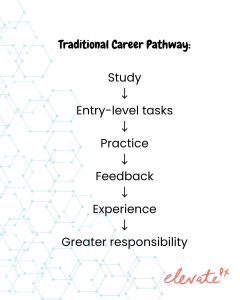
Imagine your first year in a profession.
You don’t know everything.
You learn by doing.
Someone gives you a piece of work.
You try.
You make mistakes.
Someone reviews it.
You try again.
Over time, the work becomes more complex.
Eventually, you can do things you couldn’t do when you started.
That process is how professional capability develops.
Now introduce AI.
The tool can produce the first draft.
- It can summarise the material.
- It can generate options.
- It can analyse information.
- It can write code.
- It can answer routine questions.
The organisation gets faster.
The worker gets a productivity tool.
But something else has changed.
The task that used to be a learning opportunity may no longer exist in the same form.
That is a different problem from unemployment.
The first rung matters
Think about a career as a sequence of increasingly complex tasks.
At the beginning, people often perform relatively routine work.
That work may not be glamorous.
But it teaches them the system.
- They learn terminology.
- They learn how quality works.
- They learn what good looks like.
- They learn where things go wrong.
- They learn how experienced people make decisions.
Eventually, they move up.
The routine work is not the destination.
It is part of the pathway.
AI can disrupt that pathway even if the profession itself remains in demand.
This is why the question of early careers deserves its own conversation.
The Australian report doesn’t answer this question
This distinction is important.
The government report measures employment by occupation.
Its core model uses 355 four-digit ANZSCO occupations over 45 quarters.
It examines the relationship between occupational AI exposure and employment growth.
That is valuable.
But it doesn’t tell us how individual workers acquire experience inside those occupations.
- It doesn’t tell us whether a junior worker has fewer opportunities to practise.
- It doesn’t tell us whether managers are changing how they allocate work.
- It doesn’t tell us whether organisations are deliberately redesigning learning pathways.
Those are different questions.
And they require different research.
That is where human-centred design can contribute.
Start with the junior worker
If we’re serious about understanding AI’s impact on early careers, we need to understand the experience from the worker’s perspective.
Ask a graduate:
- What tasks did you expect to learn?
- Which tasks do you actually do?
- Which tasks does AI now perform?
- What are you learning instead?
- Who checks your work?
- Where do you get feedback?
- What decisions are you trusted to make?
- What mistakes are you allowed to make?
- How do you know when you’re becoming competent?
These questions take us somewhere employment statistics cannot.
They help us understand the development of capability.
There is a potential paradox here
AI can make organisations more productive.
That is one of its attractions.
But productivity improvements can change the economics of junior work.
If an experienced worker can use AI to perform tasks that previously required a junior worker, an organisation may need fewer people to perform those particular tasks.
That could be economically rational.
But it creates a workforce-development question:
Where do future experienced workers come from?
If organisations reduce the amount of junior work available, they may eventually have fewer people progressing towards senior capability.
That isn’t a prediction that this will happen everywhere.
The Australian evidence does not establish it.
It is a design question worth investigating before the consequences become obvious.
The answer may not be “more training”
This is where the next part of the series becomes important.
The obvious response to changing work is often training.
If people need new skills, give them training.
But early-career development isn’t just about learning skills in a classroom.
People develop professional capability through:
- doing real work
- receiving feedback
- observing experienced colleagues
- making decisions
- correcting mistakes
- handling exceptions
- taking increasing responsibility
- understanding context
If AI changes the work available to junior employees, simply adding an AI course may not solve the underlying problem.
The issue may be the design of the work itself.
What would a human-centred response look like?
It might start by mapping the learning journey.
Take a role.
Break it into the tasks a person typically performs during their first six, twelve and twenty-four months.
Then ask:
- Which tasks are now automated?
- Which are augmented?
- Which remain human?
- Which tasks provide critical learning?
- Which experiences are no longer happening?
Then redesign the pathway.
- Maybe junior workers take on more complex cases earlier.
- Maybe organisations deliberately preserve some tasks because they provide important learning.
- Maybe AI is used as a coaching tool rather than simply an automation tool.
- Maybe experienced workers spend more time reviewing AI-assisted work.
- Maybe progression is based on demonstrated capability rather than time served.
There isn’t one answer.
The point is to design deliberately.
The early-career question is bigger than graduates
This isn’t only about university graduates.
It applies anywhere people develop capability through work.
- Apprentices.
- Trainees.
- Career changers.
- New managers.
- People entering a profession from another field.
- Anyone who relies on increasingly complex tasks to build experience.
AI may change those pathways differently in different occupations.
And that brings us back to the government’s exposure measures.
Different measurement systems identify different occupations as highly exposed.
- The JSA framework identifies clerical and administrative occupations among the most exposed.
- The AIOE framework produces a different ranking, including highly qualified cognitive occupations.
- The Anthropic observed measure produces another. p. 66.
So we shouldn’t assume the early-career impact will be concentrated in one obvious group.
We need to look at the work.
.vs.
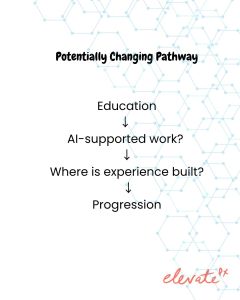
The point isn’t to claim that AI has already destroyed entry-level pathways. The report doesn’t establish that. The visual raises the design problem that this article explores.
The question I want to keep asking
The first article in this series asked:
If AI isn’t causing mass unemployment, what is actually happening?
The second asked:
What happens when AI changes the tasks inside a job?
This one takes that question one step further.
What happens when the tasks people use to learn a job change?
We don’t have enough Australian evidence yet to answer that confidently.
That’s precisely why it deserves attention.
The absence of mass job losses gives us some breathing room.
- It gives organisations time to experiment.
- It gives educators time to adapt.
- It gives policymakers time to observe.
And it gives designers an opportunity to ask a better question before the problem becomes a crisis.
How do we design early-career work so that people can still become good at the work?
Because a healthy labour market isn’t just one where people have jobs.
It’s one where people can develop the capability to do those jobs well.
Key sources: My HCD research and Australian Government, AI and employment in Australia, pp. 20-22 and pp. 63-75.
Discover more from ElevatePx
Subscribe to get the latest posts sent to your email.